Non standard traffic pattern altitudes sometimes not listed

MysteryEagle

New member
Official iFly Beta User
Joined
Jan 15, 2026
Messages
2
Reaction score
0
I'm a student pilot and recently found out that non-standard traffic pattern altitudes are not necessarily listed in chart supplement (AFD) at some airports, and surprisingly learned this by entering at the wrong altitude at my home airport KBJC (field elevation 5673, TPA 6500) - I checked iFly, saw field elevation and no TPA listed and assumed 6700 (even though I kept thinking that 6500 sounded right for some reason)

Chart supplement says nothing about pattern altitude - https://aeronav.faa.gov/afd/22jan2026/sw_342_22JAN2026.pdf - which I assume is why nothing is mentioned in iFly

The most "official" publication I found of the TPA=6500' is https://www.faa.gov/bjc "know before you go", but unfortunately these are not handled by iFly

TPA of 6500' is also mentioned in airport's noise abatement plan - https://www.jeffco.us/1694/Fly-Quiet-Program

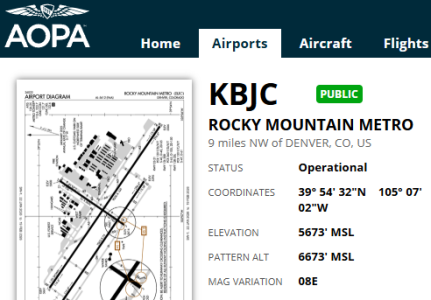
AOPA's airport information shows it as 6500' as well - https://www.aopa.org/destinations/airports/kbjc/details

And not surprisingly, Foreflight has it displayed correctly too (no screenshot as I don't use FF, but I saw it on my CFI's iPad)


Can we have this corrected for KBJC in iFly?
 
This is very interesting. Personally I primarily review the charts, the supplements and then any data provided to me via a standard briefing. Generally, I would operate based on the information provided in those publications with the mindset of "if it's not documented, then use the standard TPA of 1000' AGL." I checked FlyQ EFB and they list the TPA as "6700 MSL (estimated)". Skyvector doesn't specifically list the TPA, similar to iFly.

Since it's your home airport, does the ATIS state the correct TPA for the field? And if you are in the pattern and at 6700 MSL does the tower inform you that you are too high? The FARs "kind of" cover this by making a blanket statement that a pilot be aware of ALL information pertaining to the flight. How much research must a transient pilot perform to get ALL the information? For me... I'd be done after reviewing the charts, supplements and then information provided in a standard briefing. Do any of those things guide me to any "know before you go" documents? Maybe all pilots should now include a visit to https://www.faa.gov/flight_deck as part of our flight planning to see if any of our stops in our flight plan are on the list there.

4.3.3 of the AIM states:

"It is recommended that aircraft enter the airport traffic pattern at one of the following altitudes listed below. These altitudes should be maintained unless another traffic pattern altitude is published in the Chart Supplement or unless otherwise required by the applicable distance from cloud criteria (14 CFR section 91.155). (See FIG 4-3-2 and FIG 4-3-3):
  1. Propeller-driven aircraft enter the traffic pattern at 1,000 feet above ground level (AGL)."
... and then goes on to list other altitudes for different categories and/or types of aircraft

Although it's for safetly, I kind of put this on the FAA. They appear to be the source of the data in the supplement, the "know before you go" documents and the AIM. Why are they inconsistent and what is a pilot to do when presented with inconsistent information by the governing authority?

Should iFly review all of the "know before you go" documents and include TPA information there that is NOT found in the supplement (as it should be) and then review it regularly for updates? Maybe... and then maybe not due to the resources required to do that AND that the information should be in the supplement. Perhaps they can automate that similar to how I'm sure they parse TPA info from the supplements to include into their product.

I checked your AOPA link and it certainly does list the TPA of 6500 MSL for BJC. However, even AOPA is inconsistent:
1771449387763.png
 
I, too, am confused by that. I'm not sure why a field would have a non-standard TPA but not publish it in the Chart Supplement (A/FD). That's what the authoritative source I am supposed to have access to in the plane. I'd never even heard of the "Know Before You Go" website before this post.

FWIW, my home airport has a non-standard TPA of 800' AGL instead of 1000'. However, as far as I know that's only propagated via word-of-mouth and is not formally published anywhere--neither FF nor iFly will tell you about it. I think it might just be something the flight schools on the field came up with back in the day to help separate our traffic from the Class D only 6.5 miles away.

My point is, I dunno how many airports have non-standard TPAs that aren't well-documented, and you can also argue that if it's not documented in the Chart Supplement, is it really official?
 
FWIW, my home airport has a non-standard TPA of 800' AGL instead of 1000'.
What's your home airport identifier? I always find it odd how such local practices begin. My first airport (GPM, contract tower class D underlying the DFW Bravo) did have an 800' AGL pattern altitude but it was documented in the chart supplement. TBH... I believe the AIM lays out "recommendations" and unless documented by a valid governing authority, anyone can actually do whatever they want... that is until one big accident or several small accidents occur at a field where the FAA may then document a required practice at a particular field. Entry to a traffic pattern is one of these practices where pilots often do what's convenient for their flight even though proper entry into a traffic pattern is covered by the AIM.
 
What's your home airport identifier?
T41. We're real close to Class D EFD and not too much further from Class B HOU, so there's a lot of overflight traffic in the area. Especially for EFD, I could see potential conflict with arrivals from the east descending to 1000' for pattern entry and converging with T41 pattern traffic, so 800' at T41 does seem prudent, even though I've never seen it published anywhere officially.
 
T41. We're real close to Class D EFD and not too much further from Class B HOU, so there's a lot of overflight traffic in the area. Especially for EFD, I could see potential conflict with arrivals from the east descending to 1000' for pattern entry and converging with T41 pattern traffic, so 800' at T41 does seem prudent, even though I've never seen it published anywhere officially.
I couldn't find anything on the TPA for T41, which would typically mean pilots should fly the standard 1000' AGL for the TPA. Odd how the local pilots fly an 800 AGL TPA there. I wonder how unsafe it is for pilots to fly at TPAs 200' apart (local pilots flying 800 AGL and transient pilots flying 1000 AGL).
 
I couldn't find anything on the TPA for T41, which would typically mean pilots should fly the standard 1000' AGL for the TPA. Odd how the local pilots fly an 800 AGL TPA there. I wonder how unsafe it is for pilots to fly at TPAs 200' apart (local pilots flying 800 AGL and transient pilots flying 1000 AGL).
🤷🏻‍♂️
 
Back
Top